03 · Freelance 2025–26 · Kanslo (pre-seed startup)

Building a Research Practice from Zero

A startup building an app to help people cut their smartphone use had no researcher. How do you set up research so the team asks the right questions and can find the answers later?
MethodsResearch ops built from scratch, then a first full cycle: a literature review, six sessions with seven participants in two languages, surveys on validated scales.
Key findingEvidence only moves a product if it is findable and ranked. A page per session, every hypothesis tied to the evidence behind it and the flow step it touches, and the founders reading their users first-hand.
What changedHypotheses now sit beside the backlog, each with a plan to test it, and the first standing principle came out of the cycle: if it shames the user, it doesn't ship.

Understand + Align + (Re)design

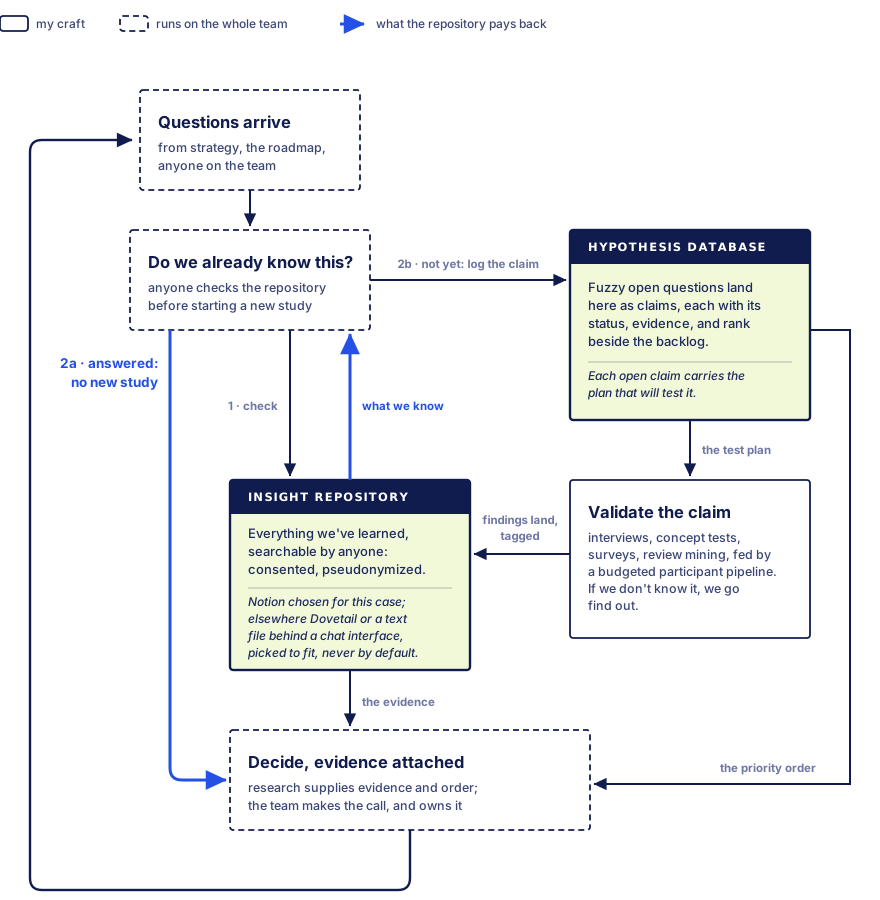
A loop diagram of the research practice. Questions from the team are checked against the insight repository. Questions already answered go straight to the decision with the evidence attached. Open ones are logged as claims in a hypothesis database, each carrying the plan that will test it, and are validated through interviews, concept tests, surveys and review mining fed by a budgeted participant pipeline. Findings land tagged in the repository, which supplies the evidence while the hypothesis database supplies the priority order, and every decision raises the next question.
Simplified graph of the system I swear by.
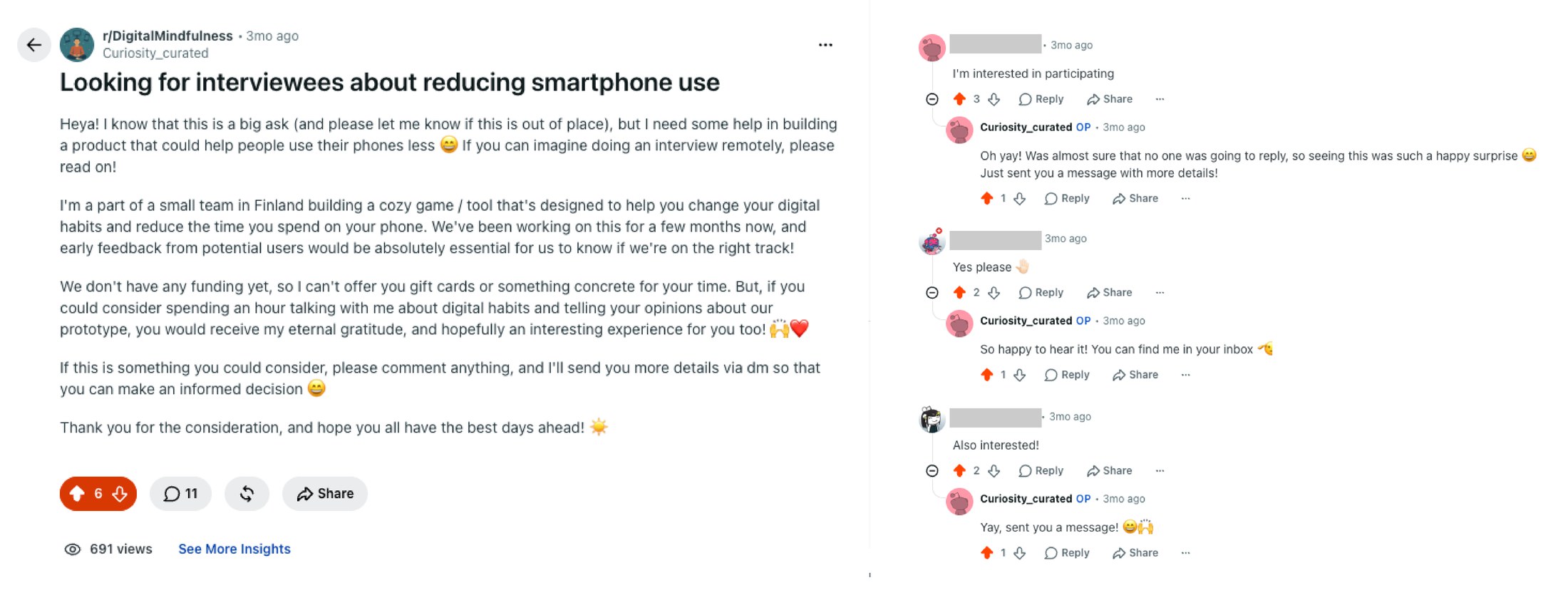
The recruiting post beside the replies it drew. The post explains that the team has no funding and cannot offer gift cards, and asks for an hour of someone's time. Three strangers answer that they are interested, and Iida replies to each personally, in one case saying she was almost sure nobody would reply. The other commenters' usernames are greyed out.
The ask, and what came back. Other commenters' names are covered; mine is not.

The storyFor a three-person team with no researcher, I picked the tooling before I built in it. The team had Google Drive and nothing else, so I moved the practice into Notion: dependencies between records, light automation, free, and fast to work in. Into it went an insight repository with a page per session, consent and pseudonymization protocols, a hypothesis database wired to the backlog, and a budgeted participant pipeline. Then I ran the first cycle: six sessions with seven participants in Finnish and English, four of them mine, working through premise, tone and mechanics in that order from screen flows on a tablet, some of which I had built myself. Recruitment mixed the team's own networks with participants recruited cold from Reddit, screened for a deliberate mix. Alongside it, a Python review-mining pipeline found the same guilt mechanic in six of seven competitor apps. The sessions had shown it too, and the team wrote it into a standing principle.

Questions or thoughts? I'd love to hear from you!

Book a 30-min call